March 2026 SAT Changes: What Bluebook Test 11 Reveals About the New Digital SAT
What’s changing on the March 2026 SAT? Bluebook Test 11 offers key clues. From increased scientific reasoning in Reading to applied algebra in Math and new Desmos updates, here’s what students and families need to know to prepare strategically and score confidently.

Cover Photo by cottonbro studio
If you’re searching for what’s new on the March 2026 SAT, you’re not alone. Families and students want to know: Is the test harder? Is scoring different? Are there new question types? And most importantly, how should we prepare?
The clearest preview comes from bluebook test 11, the newest official practice test released in the Bluebook app. Historically, when the College Board updates a practice test right before major spring administrations, it’s not random. It’s a signal. In 2025, College Board released a brand new practice test prior to the August administration that turned out to be very similar to the real August SAT.
After analyzing bluebook test 11 closely, several trends stand out. The SAT isn’t dramatically reinventing itself, but it is refining what it rewards. Here’s what that means for March 2026 test-takers.
What’s Changing on the March 2026 SAT?
The biggest shift isn’t about format. The digital SAT remains section-adaptive, and the overall structure is familiar. What’s evolving is the type of thinking being tested.
Bluebook test 11 suggests stronger emphasis on scientific reasoning in Reading & Writing, more integrated multi-skill questions, applied algebra in Math, and fewer obscure grammar traps. There are also subtle updates to the embedded Desmos calculator and possible signs of a more forgiving scoring scale.
Let’s break this down section by section.
How Is the Reading & Writing Section Changing in 2026?
More Scientific Reasoning and Study Design Questions
One of the clearest patterns in bluebook test 11 is the rise of scientific analysis within Reading & Writing. Students are increasingly asked to interpret experiments, evaluate study design, and infer conclusions from limited data.
For example, a passage might describe a natural environment (serving as a control group), introduce ship sounds as one experimental condition, and then add ship sounds plus sonic pulses as another. The student must determine what variable is being tested, why multiple experimental groups were used, and what the results imply about the hypothesis.
This isn’t about memorizing science facts. It’s about understanding how research design works. Students who can explain what was varied, what was measured, and why the study was structured that way will perform better. The SAT is rewarding scientific literacy within a reading framework.
The ACT has always had a science section. Instead of adding one, the SAT appears to be weaving scientific reasoning directly into Reading & Writing. This is even more noticeable than in previous tests, particularly in Practice Test 11.
Increased Emphasis on Inference Over Keyword Matching
Bluebook test 11 reinforces a long-standing trend: matching words from the passage to answer choices is unreliable and leads to fake-reading. If an answer choice repeats exact phrasing from the text, it is often a trap.
Instead, the test rewards paraphrasing recognition. If a passage references "foraging behavior," the correct answer may refer to "marine animals hunting for food." Students must recognize equivalent meanings expressed differently. Surface-level scanning strategies don't work for higher scorers. In our program, we specifically focus on helping students develop the skill we call "semantic equivalence" or saying the same thing using different words. Students learn to recognize that "weeds," "exotic birds," and "invasive species" will all refer to the same concept in a given passage, and the right answer will not repeat the passage verbatim but use an equivalent instead.
Transition Questions Are More Sophisticated
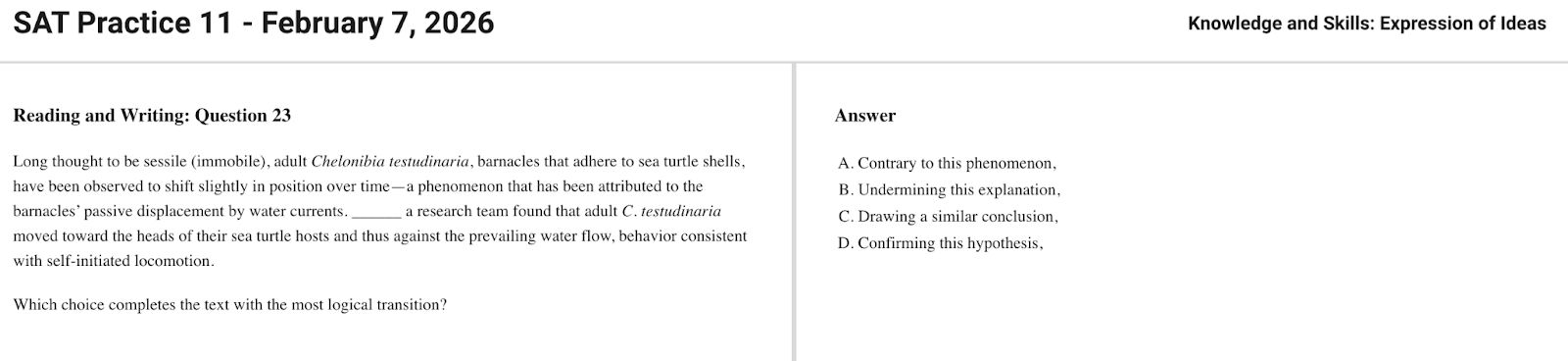
Transition questions are also evolving. Rather than simply choosing between words like “however” or “similarly,” students may need to select nuanced phrases such as “contrary to the phenomenon” or “undermining this explanation.”
Answering correctly now requires understanding not just that two ideas contrast, but exactly what is being contradicted. This blends reading comprehension with rhetorical precision in a way that demands deeper engagement.
Is SAT Vocabulary Getting Harder?
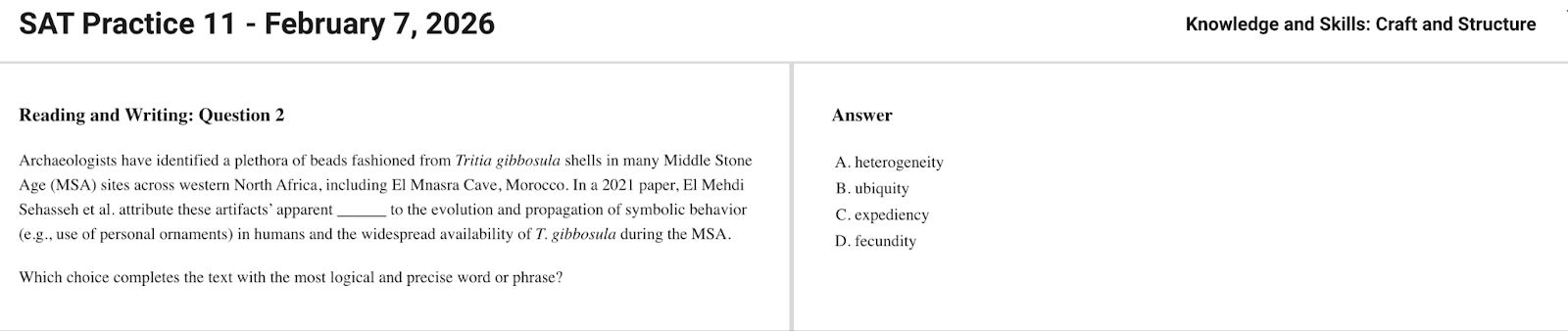
Interestingly, vocabulary on bluebook test 11 appears more practical than intimidating. The test includes solid academic words like “ubiquitous” and “quintessential,” but avoids extremely rare or archaic vocabulary.
The emphasis has shifted toward understanding meaning in context rather than memorizing obscure word lists. Students who read regularly and understand academic language in context will likely feel more comfortable than those who rely solely on vocabulary flashcards.
Are SAT Grammar Questions Changing in 2026?
Fewer Obscure Punctuation Rules
Bluebook test 11 suggests a noticeable reduction in highly technical punctuation traps. Previously, students needed to master narrow colon or semicolon rules that felt uniquely “SAT-specific.” These appear less frequently.
Instead, grammar questions focus more on clarity, logical flow, and effective expression.
Greater Focus on Logical Construction
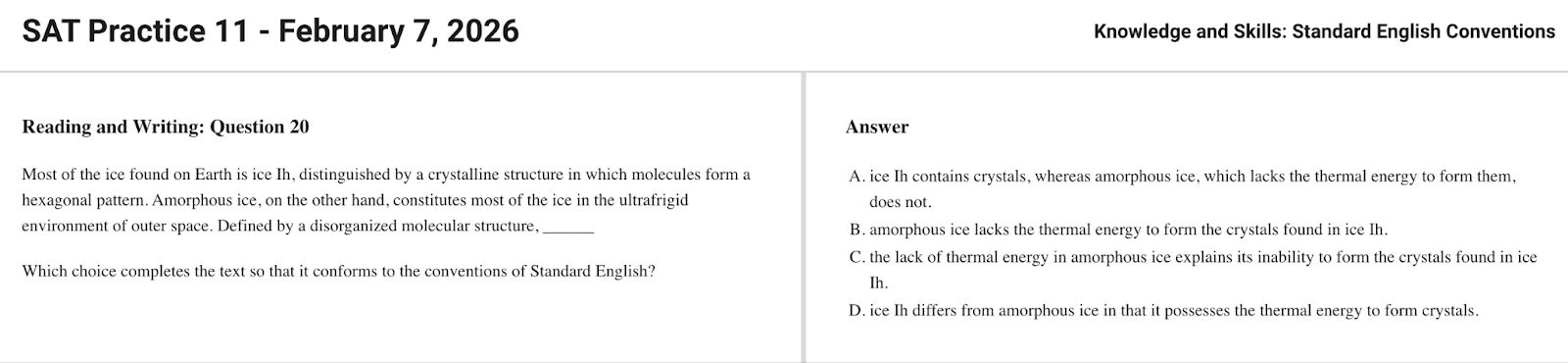
Dangling modifiers appear more prominently. Sentences that technically follow punctuation rules but fail logically are being tested more directly. Students must ensure that modifiers clearly refer to the correct subject and that sentence structure reflects logical meaning.
This shift suggests that the SAT is prioritizing real-world writing clarity over technical grammar trivia.
Are Bullet Point Questions More Difficult?
Yes, and in a subtle way.
In earlier versions of the digital SAT, some bullet-point questions could be answered quickly without revisiting every detail. Bluebook test 11 requires more careful verification. Students must return to the bullet points and confirm that each answer choice is fully supported by the data provided.
Many incorrect options sound reasonable but contain small inaccuracies. The test is clearly rewarding careful evidence checking rather than quick assumptions. Here is a great example below.
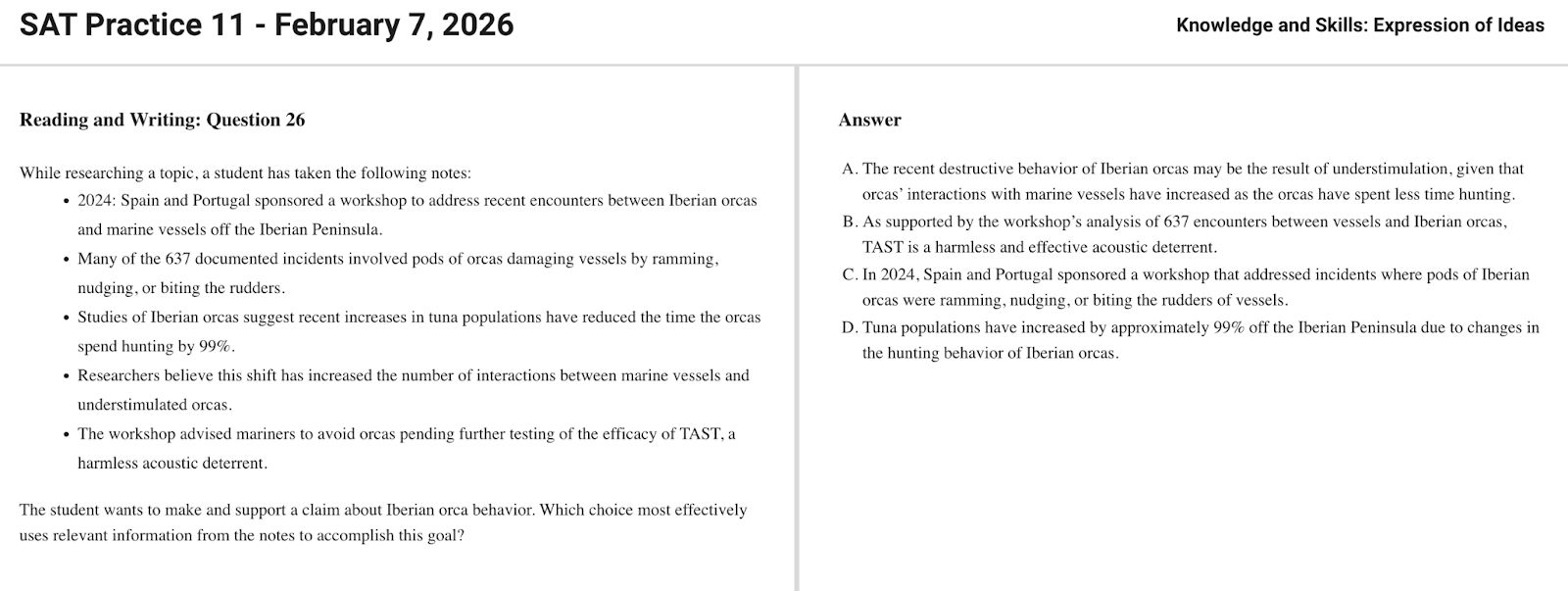
Just take a look at what D pulls here: it lifts that 99% straight from the notes like it's citing precedent, name-drops both tuna and orcas so it sounds airtight, and wraps it all up in this neat little scientific package that practically screams "pick me." But it completely reverses cause and effect. The notes are crystal clear: tuna populations went up, so orcas hunted less - by 99%. D flips it and says tuna populations increased because orcas changed their hunting behavior. That's not just wrong, that's the legal equivalent of claiming the verdict caused the trial. Nice try, College Board, but I've seen this move before.
What’s New in SAT Math for March 2026?
Continued Emphasis on Algebra
Algebra remains central, particularly linear equations. Approximately one third of the Math section still relies heavily on linear relationships and their applications. However, questions are increasingly layered.
Students may need to interpret a graph like the line of best fit, translate it into an equation, and apply a transformation within a single problem. Bluebook test 11 shows more multi-step reasoning embedded in one question rather than isolated skill testing.
More Applied and Real-World Context
Rather than solving abstract equations in isolation, students are asked to apply algebra in practical scenarios. Graph interpretation, function shifts, and contextual problem solving appear more frequently.
This rewards students who understand concepts deeply rather than those who rely on memorized procedures.
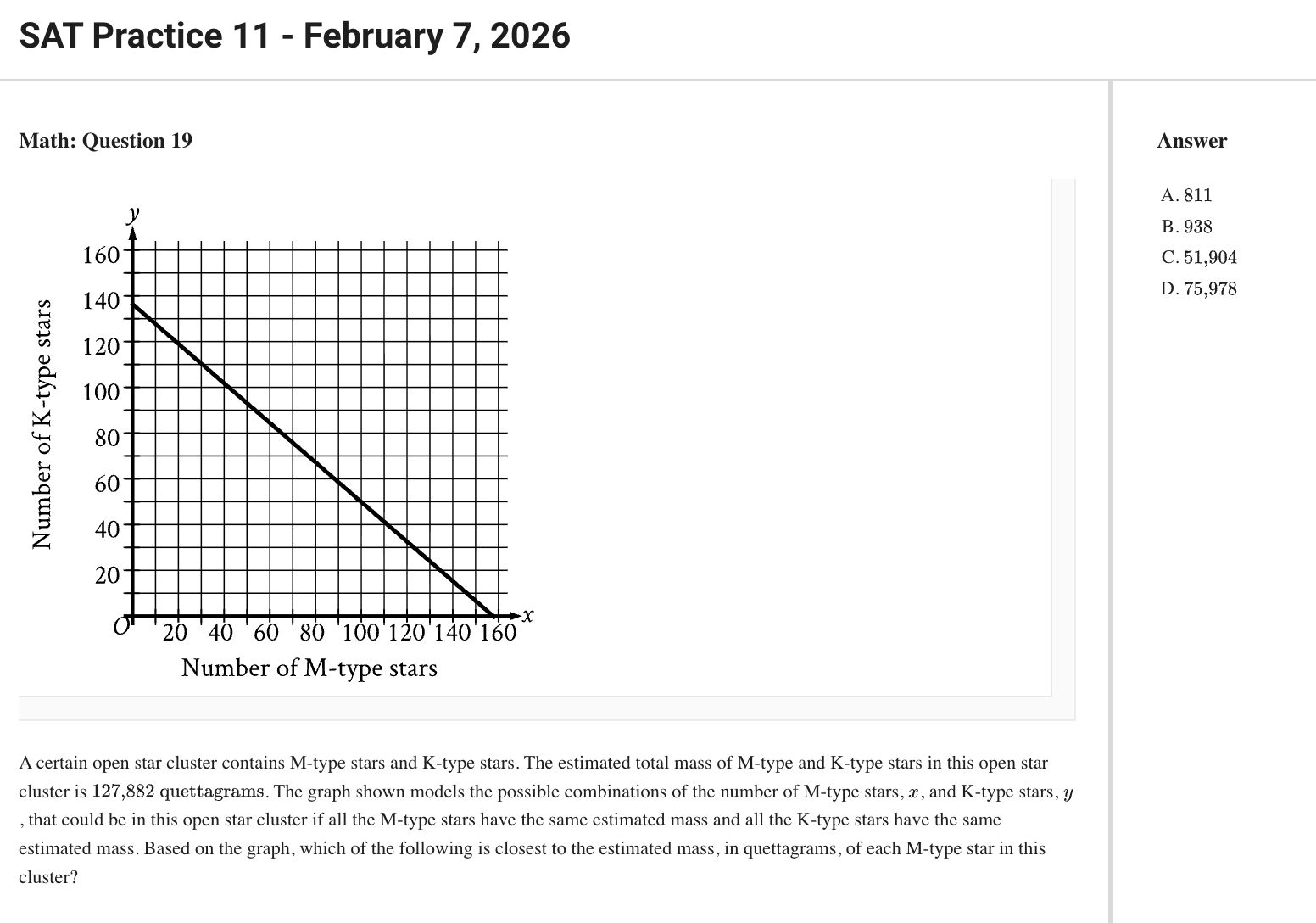
This question is a perfect example of how the 2026 SAT has evolved. It is testing whether students actually understand what they are doing. The graph shows you the relationship between M-type and K-type stars, and you need to interpret what that line actually means in context of the total mass. If you were taught to just plug and chug - punch numbers into equations without grasping the underlying math - you're going to hit a wall here. This isn't about memorization, it's about comprehension. And here's the thing: we saw this coming. That's why we created a special lecture called "Possible Combinations" that breaks down exactly these types of questions (the ones that require you to read data, interpret relationships, and apply logical reasoning instead of just regurgitating formulas.) Because knowing how to solve something and understanding why you're solving it that way are two very different skill sets, and the SAT knows it.
Can Students Still Rely on Desmos to Solve Everything?
Not entirely.
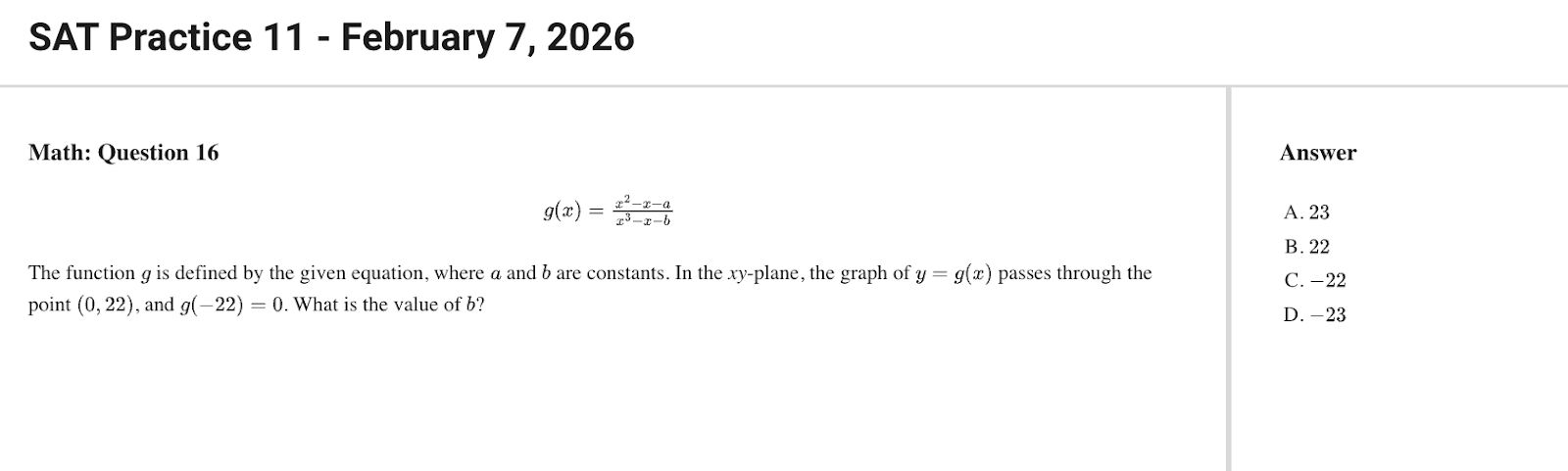
The Desmos calculator remains embedded in the Bluebook app, but some questions in bluebook test 11 appear designed to discourage blind calculator usage. Problems with more unknowns than equations, or scenarios requiring structural insight before graphing, can waste time if approached incorrectly.
Students who understand the math concept first, and use Desmos strategically, will have a significant advantage over those who immediately start plotting without analysis.
Is There a New Desmos Update in Bluebook?
Yes. Bluebook now allows students to toggle between graphing mode and scientific calculator mode within Desmos. This added flexibility can streamline certain calculations, but it requires familiarity. Students should practice switching between modes before test day to avoid losing time.
Is Statistics Becoming More Important on the SAT?
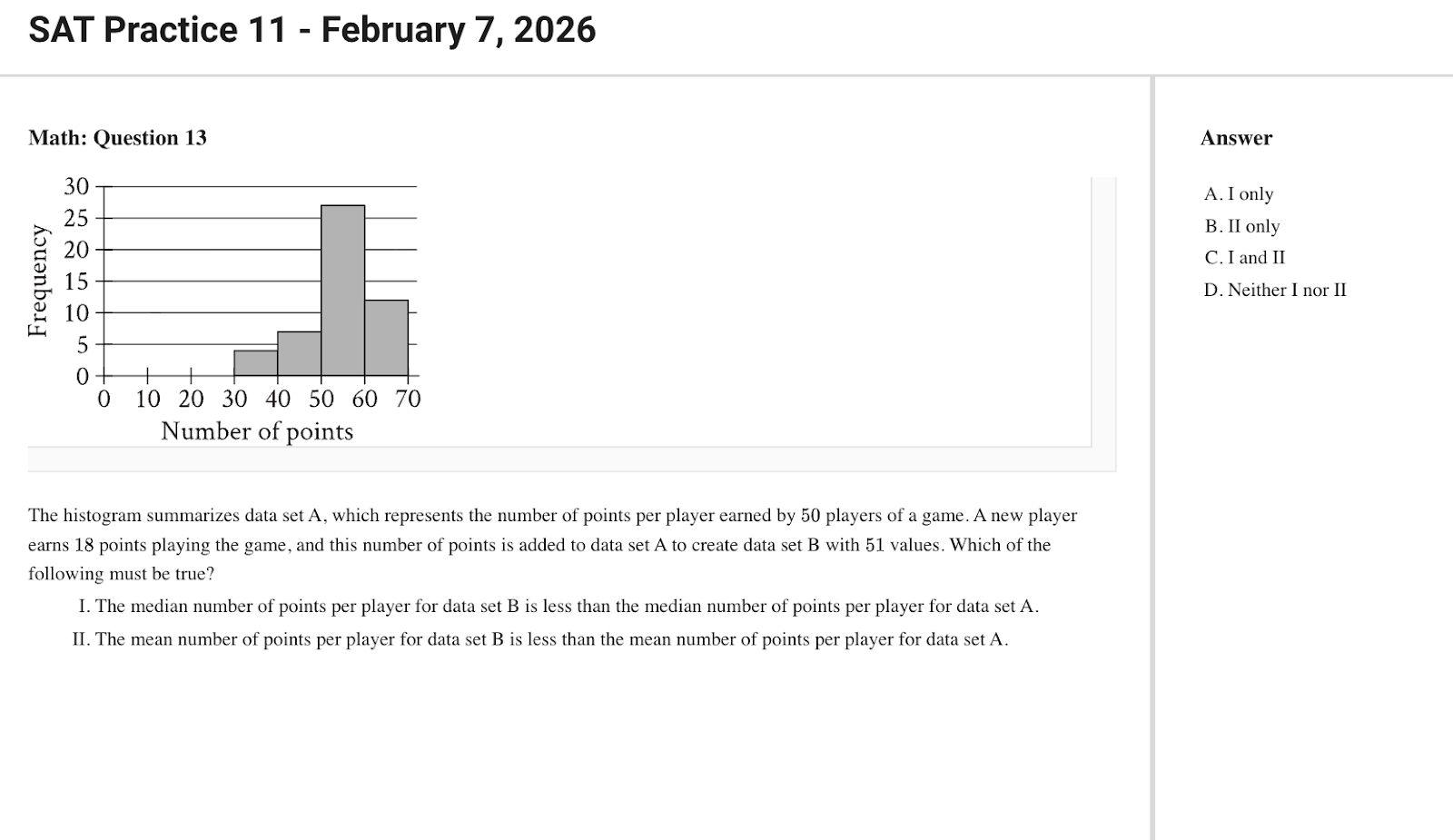
Bluebook test 11 includes noticeable representation of statistics concepts such as line of best fit, histogram interpretation, and probability. Students who understand mean versus median, including which measures are resistant to outliers, will navigate these questions more efficiently.
While the SAT does not require advanced statistics coursework, familiarity with foundational concepts is increasingly beneficial.
Is the March 2026 SAT Scored More Generously?
Preliminary observations from bluebook test 11 suggest that scoring may be slightly more forgiving. In some cases, multiple mistakes resulted in relatively modest score reductions, possibly around 10 points per error.
While it’s impossible to confirm whether this exact scaling will apply in March 2026, early data indicates that a small number of errors may not be as heavily penalized as in past versions.
How Should Students Prepare for the March 2026 SAT?
Preparation should focus less on tricks and more on skill integration. Students should practice analyzing study designs in reading passages, strengthen applied algebra skills, review core statistics concepts, and refine logical writing clarity. They should also use bluebook test 11 as a diagnostic tool, carefully reviewing not just wrong answers but the reasoning behind correct ones.
The March 2026 SAT does not represent a dramatic overhaul, but it does reflect a thoughtful refinement. The exam increasingly rewards students who think critically, reason scientifically, and communicate clearly. Those who recognize these shifts now will approach test day with greater confidence and stronger results.
If you’re interested in an SAT prep course, we encourage you to check out our SAT Boost program. And if you have any questions, we’d love to talk with you. Set up a time here to make sure Ivy Tutors Network is the right fit for you - we’re ready for all your hard questions.