

What Your Child's Adaptive SHSAT Practice Score Means
How to interpret a challenging mock test, compare results accurately, and take the next steps in your child’s preparation.

A difficult adaptive SHSAT practice test can leave students discouraged, and parents wondering what the score actually means. Take a breath! Before you compare this result with an earlier one, check whether the two tests used the same format (item adaptive vs linear, digital vs paper) and the same scoring method. And remember, a mock exam is most useful when it shows you what to work on next: the questions your child missed, where time ran short, and which strategies need more practice.
If your child participated in our inaugural free adaptive mock SHSAT on Saturday, October 10, 2026, thank you for joining us (virtually, that is)! If your child finished, congratulations. You (vicariously) ran an academic marathon, and your student took a real step toward the actual exam. Here is how to make sense of the result.
What can a mock SHSAT score tell you, and what can't it?
A mock score is a preparation tool. It is not an official SHSAT score, and it is not an admissions prediction.
Your score can show you which skills and question types need attention, how your student handled timing, and how comfortable they are with the digital format. It cannot tell you where your child will land on the official exam, and it cannot tell you where any school's cutoff will fall. Focus on the input, not the output - that is, focus on the question types that need review, as well as your student’s pacing and testing tactics, rather than fixating on their score.
Why can an adaptive SHSAT practice test feel so challenging?
Because an adaptive test chooses questions based on how a student responds.
The digital adaptive SHSAT is designed in such a way that it feels harder. Many people, when they think about a test, imagine a fixed set of questions where everyone answers the exact same items in a predetermined order, with the freedom to skip around. That's a linear test design, and the SHSAT is no longer linear.
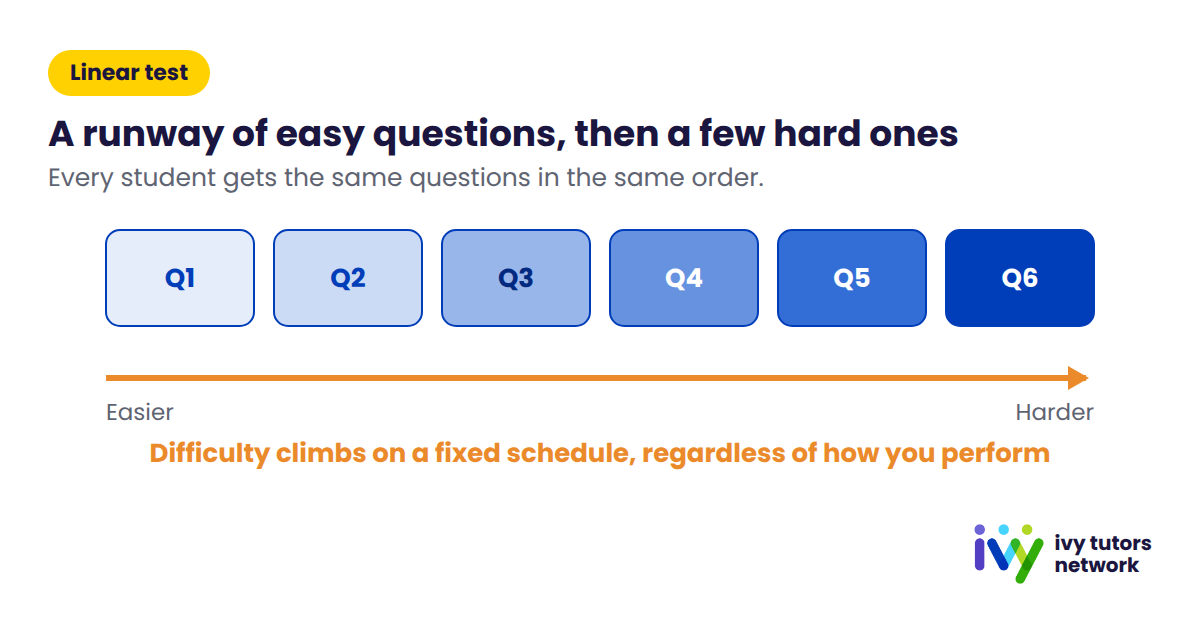
Instead, the new computer-adaptive format adjusts in real time based on your student's live performance. Per NYC Public Schools' current SHSAT guidance, the official exam begins with questions of average difficulty, then adjusts what comes next based on student responses. If they answer correctly, the test serves up harder items and if they struggle, the questions become easier.
To help prepare students for this shift, our Mock Exam App is built to mirror that exact adaptive experience, including all the new technology-enhanced items (TEIs). As you keep answering, the testing algorithm feeds you questions that are adjusted to your level. For the SHSAT, those level-adjusted questions are supposed to be challenging but answerable.
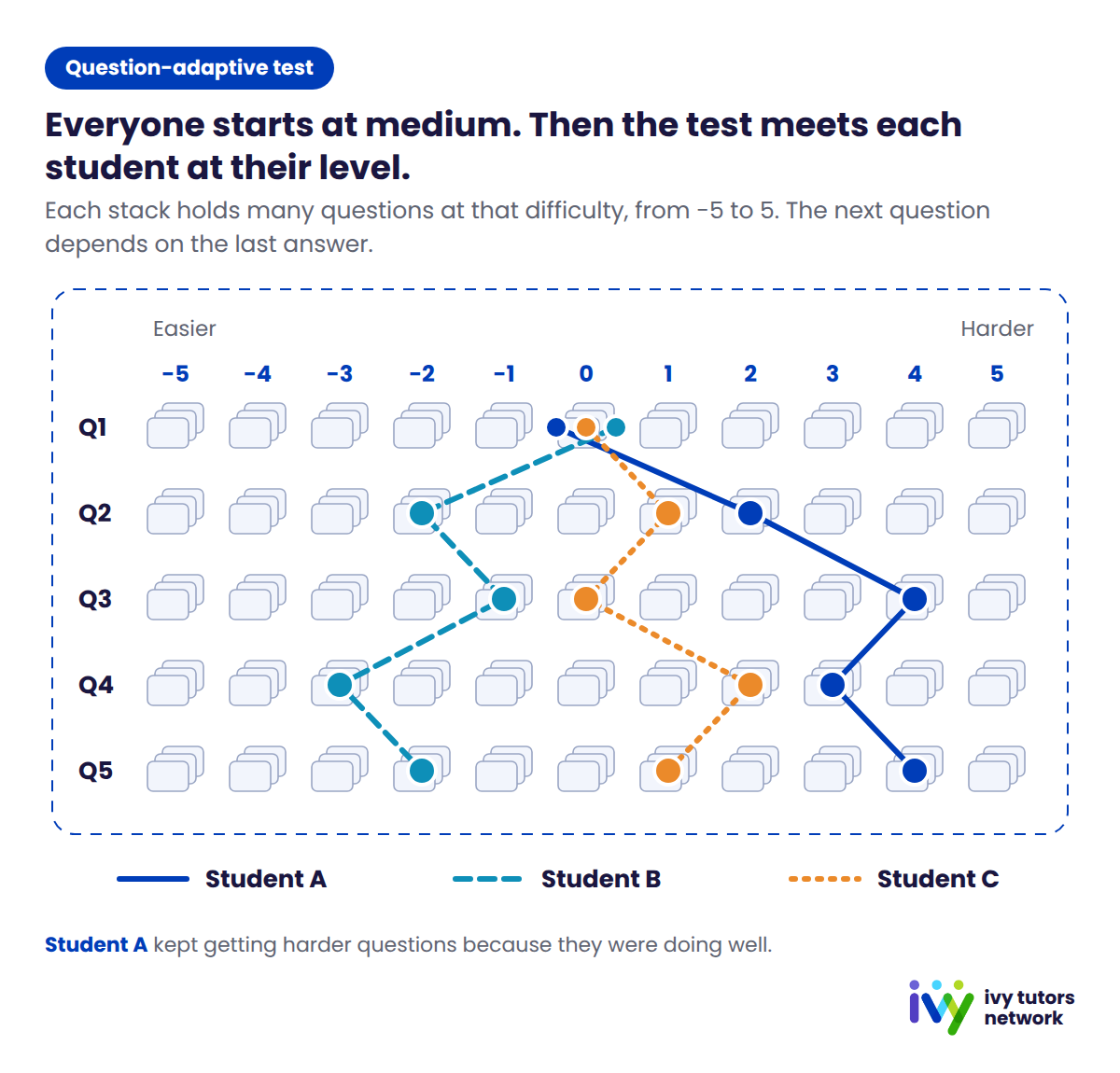
Item-adaptive test design depicted above creates a highly personalized assessment, but it also means that students will feel challenged throughout the entire test. On a digital adaptive exam, there is no gentle runway of easy questions leading up to a few hard ones at the end. Instead, students, irrespective of their testing ability, will feel as though they are working at the absolute edge of their skill level for the duration of the test. Even the highest-performing students will not feel like it is a breeze.
While facing consistently challenging questions is great for your student’s prep, and means the test is working by design, such constant rigor requires a higher level of stamina and advanced decision making skills. Parents and students beware: this shift of formats often comes with a drop in practice test scores when compared to older non-adaptive tests. Some of it is attributed to the novelty of the TEI questions but most of the drop is due to the added cognitive challenge.
If you see a lower score, it doesn’t automatically mean that your student is suddenly in trouble. It just means that they’re now getting an honest look at a question adaptive testing model that is designed to challenge students at every step.
Want the full picture of how the format works? Our adaptive SHSAT guide goes deeper.
How do you review your child's score report?
Start with the work, not just the number. We always say to our students, "Focus on the input, not the output." By input, I mean their work, and the output is the score.
Sit down with your child and go through the following (given that the report provides this information):
1 - What does the error show? Is it a content gap, misread directions, or rushed work? Students will usually say they rushed or weren’t paying attention. When you push a little harder, though, the real cause is often a content gap or a break in logic. To find it, we ask students to close their notes and walk us through their steps out loud, in complete sentences. Visual thinkers can write the steps out on paper instead, still with notes closed.Parent advisory: This is a lot easier to do with a tutor, because getting your child to reflect on their thinking may mean being a little unpopular with your kid for a while.
2 - What type of error keeps repeating? Repeated errors point you to the lowest-hanging fruit. Ratios and percentages, for example, show up again and again. If those are a strength, great. If they’re a weakness, that’s where to start, because fixing one topic will pay off across many questions.
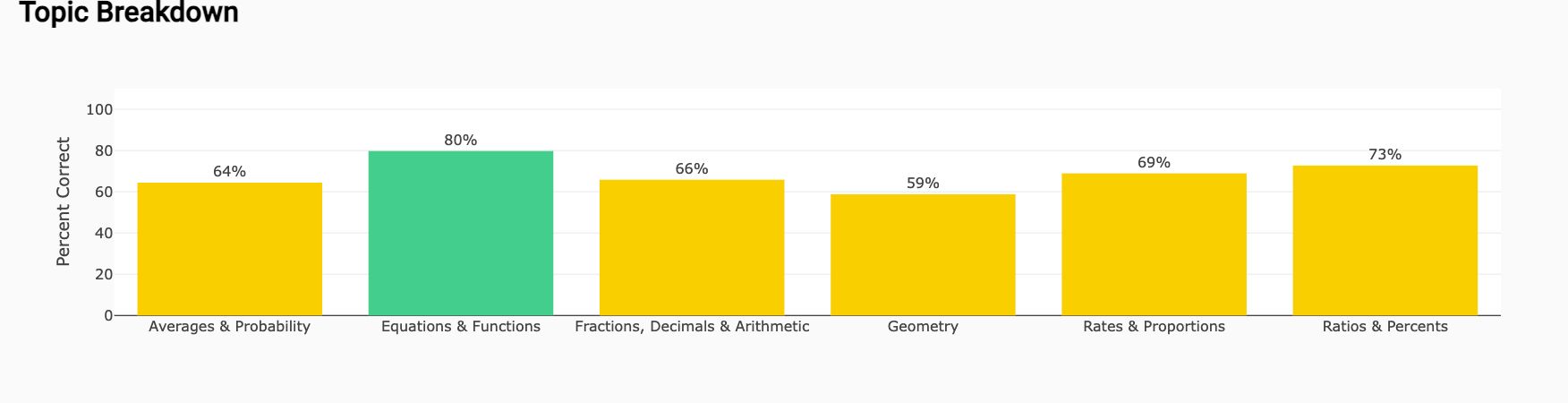
For high scorers, look beyond which questions your child got wrong and check how long each one took. This is why our report shows time per question.
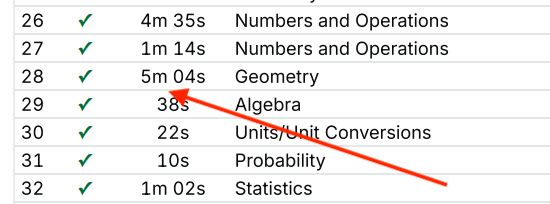
A correct answer that took five minutes usually means the approach is wrong, even if the answer isn’t. That student got lucky with persistence, but it won’t hold up under real test timing.
3 - What are the two most useful changes to your student’s study plan? Once you’ve identified the low-hanging fruit, build those question types into your child’s daily routine. Short, consistent practice beats occasional long sessions. In our program, we use Mathchops, a tool designed specifically for SHSAT students. It builds mathematical fluency and keeps concepts fresh so students don’t forget what they’ve already learned. You can complement it with the IXL and worksheets.
Our diagnostic and mock testing service is one way to get a score report to work from.
Two critical habits to develop for the adaptive SHSAT.
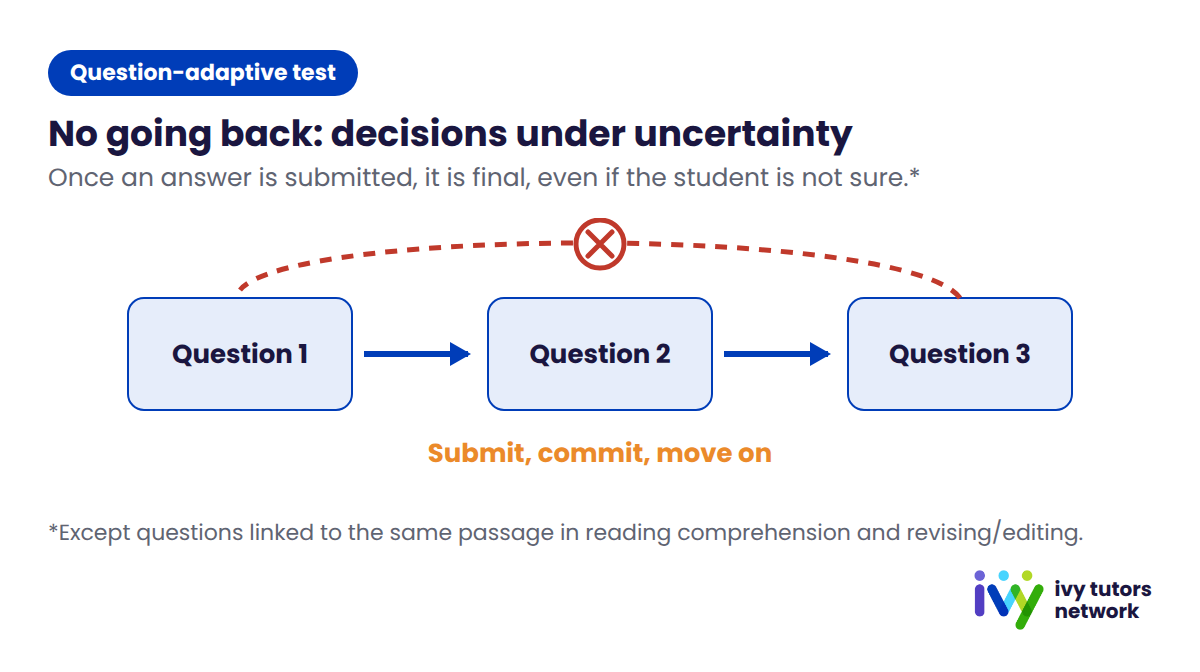
The first is flexible decision-making in the face of uncertainty. Your student will have noticed that for most questions on the digital adaptive SHSAT, there is no going back once an answer is submitted (unless you are navigating to a previous answer linked to the same passage as your current answer in the reading comprehension and revising and editing sections).
This part is hard psychologically. When students get stuck, they need to push themselves to try a different approach (flexible thinking) , and then commit to an answer even if they’re still not sure it’s right. That decision is final, so they have to make peace with it and move on. We find it helpful to tell students that there may be questions on the test that they have not seen, so they don't panic when that happens. Our tutors also model the thinking habits and self-talk that help in those moments, so students know exactly what to think and do when a question completely stumps them. As a parent, you can model such flexible thinking out loud with your child as well.
Students’ best option is to practice flexible problem-solving and decision-making until it becomes a habit, and until they’re comfortable with approaching the test in this way.
The second crucial habit is pacing. The SHSAT gives students 180 minutes (360 for double time) to tackle 100 questions, split evenly between ELA and Math. While students can choose which section to start with, there is a major catch: you can no longer skip around to find the easy questions first, and there is no going back. Because the computer-adaptive algorithm dictates the order and locks past responses, students must answer questions as they come and double-check their work on the fly.
We advise starting with their stronger section to build momentum, aiming to finish it in 90 minutes or less. They should not rush. Rushing leads to sloppiness, which leads to errors. Students should move briskly through easier questions to bank a 3 to 4- minute cushion for the hardest questions, making an educated guess when stuck.
Regular practice tests will help them internalize this natural rhythm so they can confidently submit each answer and move forward without staring at the clock.This is where our time-per-question report comes in handy. Parents, tutors, and students can see exactly where time was overspent and work on solving similar questions faster.
We can’t reveal all our tutoring secrets here, but one principle holds every time: the key to a question lies in reading everything it gives you. The clue is often hiding in the question stem or the answer choices. Building the habit of first noticing what’s given, then working out what’s being asked and how to get there, is the skill.
A note on SHSAT Digital Scoring & Cutoff Scores
This is the first year the NYC DOE has implemented a computer-adaptive SHSAT. That means no one knows how students across NYC are going to do under the new digital format, which means that no one knows the exam’s exact SHSAT curve or where specialized high school cutoff scores will land. The best SHSAT prep strategy under this uncertainty is to get your student used to this digital-adaptive test format and to expose them to ample, challenging, exam-level questions using realistic SHSAT mock exams. That will ensure that they know what they are doing, and that they can do their best work on the day of the actual test!
What should the next weeks of preparation look like?
- Practice flexible decision-making and pacing.
- Use your recent score report(s) to identify the skills and/or concepts your student is struggling with. Whether that’s remembering to check their work, analyzing poetry passages, or solving geometry problems, work at these skills to improve through short, targeted practice sessions.
- Most importantly, take more digital adaptive SHSAT mock exams. The best thing you can do is to make sure your student is exposed to this new testing model and to realistic, challenging exam questions as much as possible. Gaining experience with adaptive SHSAT practice tests ahead of test day is absolutely critical.
We’re biased, but our digital adaptive tests are the best in the business, and they come with detailed score reports you need to target their areas of growth.
Your child is better prepared for the SHSAT post-mock exam, because they've now seen what the adaptive format actually feels like. Their initial practice score is ultimately less important than the invaluable experience they gained for the real test!
How can Ivy Tutors Network help?
The team at Ivy Tutors Network is here to support you in the home stretch, whether that's with additional mock tests or with an individualized plan.
Need help deciding what to work on next? Explore our SHSAT preparation options and talk with us about a plan for your child.
Frequently asked questions
Can I compare this result with a previous practice test?
Probably not. Unless both tests used the same format, scoring scale, and testing conditions, you’d be comparing apples to oranges. For a fair comparison, take another practice test on MockExamApp.com. Our engine won’t show your student any questions they’ve already seen.
Does feeling challenged mean my child is doing badly?
Not necessarily. How a test feels is not enough to interpret performance. Review the result and your child's work before deciding what needs attention.
What should we do after a disappointing result?
Identify a small number of skills or habits to work on, practice them deliberately, and review progress under comparable conditions. The next step should come from the evidence in your child's work.
Is an adaptive SHSAT practice score the same as an official SHSAT score?
No. A practice score is a preparation tool. It comes from the practice provider's own questions and scoring method, so it isn't an official score and can't predict admission or cutoffs. For official testing information, see NYC Public Schools.
Official sources
- NYC Public Schools: Specialized High School Admissions Test (current format, navigation, and scoring)
- NYC Public Schools: SHSAT digital and adaptive transition (timing and transition details)
About the author
Katya Seberson is Co-Founder and Chief Academic Officer of Ivy Tutors Network and led the team that built MockExamApp.com, Ivy's adaptive SHSAT practice platform. A perfect scorer on the SAT and ACT, she has taught test prep in New York City since 2013.