
How to Write the Columbia Application: The Reading List, the Lived Experience, the Disagreement, the Adversity, and the Two Why Essays
Columbia's application asks students to reveal themselves in six very different shapes: a list, two personal narratives, a disagreement, and two "why" essays. Here's how to approach each one so they add up to a single, coherent mind instead of six disconnected homework assignments.

What Are the Columbia Supplemental Essay Prompts for 2026-2027?
For the 2026-2027 application cycle, Columbia University asks applicants to complete six supplemental essay responses: one 100-word list of intellectual resources and five short responses of up to 150 words each.
The six questions cover:
- Intellectual interests: A list of books, publications, websites, podcasts, and other resources that have shaped your intellectual development.
- Lived experience: How an important aspect of your background will shape your contributions to Columbia's collaborative community.
- Disagreement: A time you disagreed with someone and what you learned from the interaction.
- Adversity: A challenge you navigated and how it changed you.
- Why Columbia: Why you want to attend Columbia University.
- Why your major: What attracts you to your intended academic field.
Each response serves a different purpose. The goal is to give admissions readers a multidimensional understanding of how you think, learn, and contribute.
Columbia Isn't Testing Six Separate Answers. It's Testing One Reader's Patience for Six Different Kinds of Compression.
Columbia's supplement asks for more registers than almost any other school's. A 100-word list. Three separate 150-word narrative prompts, on lived experience, disagreement, and adversity. A 150-word "why Columbia." A 150-word "why this major." Five of the six pieces are shorter than a single paragraph of your personal statement, and every one of them is competing with the same amount of a reader's attention.
The most common mistake we see is treating each piece as its own isolated assignment: brainstorm the list, then brainstorm the lived experience, then brainstorm the disagreement, without ever stepping back to ask whether they're circling the same territory. A student who uses "translating for my grandmother" in the lived-experience essay and then reaches for a version of the same story in the disagreement essay has spent two of six precious slots saying one thing twice.
Before drafting anything, map what each of the six pieces is actually going to reveal. Then write them in the order below, which is also the order Columbia asks for them.

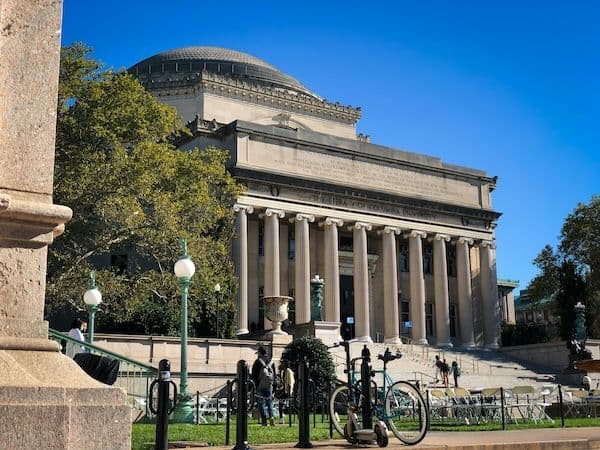
Photo by bram naus on Unsplash
Columbia Supplemental Essay 1: Intellectual Resources List
"List the titles of texts, resources and outlets that have contributed to your intellectual development outside of academic courses, including but not limited to books, journals, websites, podcasts, essays, plays, presentations, videos, museums and other content that you enjoy." (100 words or fewer)
Do this: choose items that triangulate one specific mind, not a resume of impressive titles. Five completely unrelated prestige picks (a canonical novel, a hard-science journal, a foreign film, a philosophy podcast, a museum) prove only that you've encountered a lot of media. A list where four or five items are quietly circling the same real question does far more work. A student fascinated by how cities fail the people living in them might list a podcast on transit policy, a documentary on a housing crisis, a novel about a neighborhood being redrawn by a highway, and an afternoon spent at a transit history exhibit. None of those items announce the theme. Read together, they show it.
Do this: order for rhythm and meaning, not chronology. You don't need to list these in the order you encountered them. Put the two that talk to each other most clearly next to one another.
Avoid this: don't include a title you can't speak to. If an admissions reader (or an interviewer) asked you to explain why a book on your list matters to you, and you'd struggle, cut it. This list is short enough that every item has to have earned its place.
Columbia Supplemental Essay 2: Lived Experience
"Tell us about an aspect of your life so far or your lived experience that is important to you, and describe how it has shaped the way you would learn from and contribute to Columbia's multidimensional and collaborative environment." (150 words or fewer)
Do this: hold your insight until the very last beat, not the middle. At 150 words, it's tempting to state the lesson as soon as you've set the scene, then spend the remaining space justifying it. The stronger structure is the reverse: let the concrete detail do the setup, and let the realization land in the final one or two sentences, growing directly out of the last image rather than being announced ahead of it.
Do this: look past the obvious payoff for a truer, smaller one. A student who grew up as the only English speaker at family gatherings, translating for older relatives, has an available and somewhat expected essay: translating taught me patience, or taught me to listen. A more honest version might notice that translation is never exact, that something is always added or lost in the process, and that this is what actually made her comfortable holding two people's opposing accounts of the same event in a classroom discussion without needing to resolve them. The second version is smaller and stranger, and it's the one that sounds like a real mind rather than a moral.
Avoid this: don't spend your limited words explaining why the experience mattered before you've shown it.Show first. Let the reader feel the shift before you name it, and once you've named it, stop.
Columbia Supplemental Essay 3: Disagreement
"At Columbia, students representing a wide range of perspectives are invited to live and learn together. In such a community, questions and debates naturally arise. Please describe a time when you did not agree with someone and discuss how you engaged with them and what you took away from the interaction." (150 words or fewer)
This is the prompt students most often turn into a victory lap. The instinct is to end with "I made my case, and by the end they came around," or some version of having won. Readers have seen that ending hundreds of times, and it rarely tells them anything about how the writer actually thinks.
The other common failure runs the opposite direction: "we agreed to disagree." That ending sounds mature, but it's just as much of a non-answer, because it tells the reader nothing changed in you either. The only version of this essay that actually works is some form of the disagreement making you more curious about the other person's point of view, not less. That's the shift to aim for.
Do this: end on a change in your own method, not a change in the other person's mind. A student who argued with a grandfather over dinner about whether renewable energy subsidies were worth their cost has a much stronger essay if the turn isn't "I convinced him," but something narrower and more honest: partway through, she stopped stacking rebuttals and started asking what it had actually been like to live through the blackouts he kept referencing. The disagreement didn't resolve. Her approach to disagreement did.
Do this: name the shift as a specific, concrete move, not a vague virtue. "I learned to listen better" is a claim. "I asked him what those three days without power in 2019 had actually been like for him" is a scene. Write the second kind.
Avoid this: don't manufacture a tidy resolution. An honest, unresolved disagreement, engaged with seriously, is a stronger answer than a debate you happened to win.
Columbia Supplemental Essay 4: Overcoming Adversity
"In college/university, students are often challenged in ways that they could not anticipate. Please describe a situation in which you have navigated through adversity and discuss how you changed as a result." (150 words or fewer)
Do this: keep the adversity itself brief. The event is setup, not the essay. A student who tore an ACL and lost a varsity starting spot, then spent the season coaching freshmen instead of playing, doesn't need more than two or three sentences to establish the injury. The essay is what happened to her sense of who she was once the game she knew how to play was taken away.
Do this: state the change as a direct, checkable claim in your final lines. Not "I learned resilience," which could describe almost anyone, but something specific enough to picture: "I stopped needing to be the best player in the room to feel like I belonged in it." That's a claim a reader can actually verify against the rest of your application, which is exactly what makes it convincing.
Avoid this: don't hedge the realization with "I realized" or "I found" or similar qualifiers. State it as a fact about who you are now, not as a memory of the moment you noticed it.
Columbia Supplemental Essay 5: Why Columbia?
"Why are you interested in attending Columbia University? We encourage you to consider the aspect(s) that you find unique and compelling about Columbia." (150 words or fewer)
Do this: ground the essay in one or two real, unresolved questions before you mention Columbia at all, and connect them to one of Columbia's two truly distinctive features: the Core Curriculum or the New York City location. Almost everything else a student names (small seminars, a particular major, undergraduate research) exists in some form at plenty of other schools. The Core and the city don't. The weakest version of this essay opens with Columbia and works backward to justify it. The stronger version opens with what you've already been wondering, and only then shows how the Core or the city is built to keep wondering it. A student who spent a summer mapping which blocks in her neighborhood flood every year, and who is still unsure whether the fix is better infrastructure or better policy, is in a strong position to connect that question to the city itself, treating New York as the ongoing case study the rest of her education would sit inside, not as a backdrop.
Do this: let a genuine question, not a list of features, be the connective tissue. "Would a Core class built entirely around primary texts change how I argue about a housing policy I already care about, or just give me new footnotes for the same argument?" does more work than a paragraph naming programs.
Avoid this: don't list buildings, neighborhoods, or program names without tying each one to something you're actually asking. If the Core comes up, name the actual tension you expect it to create with what you already think, not just that it exists. If the city comes up, name the specific way you'd use it, not that it's "vibrant" or "unlike any other campus."
Columbia Supplemental Essay 6: Why Your Intended Major
"What attracts you to your preferred areas of study at Columbia College or Columbia Engineering?" (150 words or fewer)
Do this: name the moment the interest actually turned technical, not just the moment you got interested. A student who loved music and then, almost by accident, started using code to model the overtone patterns in a chord, has a sharper essay than one who simply says she's "always loved both music and science." The turn from appreciation to method is the real material.
Do this: let one governing image or question carry the field, instead of listing its subfields. Rather than naming every corner of computational biology you find interesting, pick the single thread, layering, pattern, translation, whatever it actually is for you, and let it organize the whole 150 words the way a controlling image organizes a personal statement.
Avoid this: don't just restate your intended major from the Common App in different words. This space exists to show the reader how you think inside that major, not that you have one.

Photo by Kai Kim on Unsplash
A Note on the Application as a Whole
Because three of Columbia's six prompts, the lived experience, the disagreement, and the adversity, are all narrative and all roughly the same length, they're the pieces most likely to accidentally overlap. Before you finalize any of the three, lay them side by side and ask what distinct territory each one is covering. If two are drawing from the same relationship, the same activity, or the same underlying lesson, move one of them somewhere else entirely. You have exactly three chances in this supplement to show a reader a new side of your thinking through a full scene. Spending two of them on the same side costs you a chance you don't get back.
FAQ
Do all six pieces need to connect to one theme?
No, and forcing a single theme across all six usually reads as manufactured. What matters more is that the three narrative prompts each cover different territory and that the two "why" essays don't repeat each other.
How different should the lived-experience and adversity essays be from each other?
Different enough that a reader who has only read one of them couldn't guess the content of the other. If both essays could plausibly be about the same event, choose a different event for one of them.
Should the "why major" essay repeat content from the “why Columbia?”
It can share a general interest, but it should not repeat the same wonderings or the same resume elements. Use the Why Major to go one layer more technical than the Why Columbia.
Is it risky to answer the disagreement prompt without a clean resolution?
No. An honest, unresolved disagreement that you engaged with seriously is usually a stronger answer than a debate you happened to win.
How much does the 100-word list actually matter?
More than its length suggests. It's often the first piece of the supplement a reader sees, and because it's a list rather than a narrative, it's one of the few places where a reader can see your taste directly, without any of it being shaped for effect.
Don't be afraid to ask for help!
Your story is yours to tell, but you don't have to write it alone. Get expert guidance from IVY's college essay tutors, who have helped countless students turn their ideas into standout essays and earn offers from their top schools.
Find your story. Perfect your draft. Strengthen your shot at admission. Get expert essay help today.
Need a second set of eyes on your Columbia supplement?
Six prompts, six different lengths, one reader forming an impression across all of them. IVY's college essay advisors can help you map the whole supplement before you draft a single word, so nothing overlaps and nothing gets buried.
Get expert help with your Columbia essays
About the author:
Justin Taylor is a college admissions consultant specializing in selective university applications and undergraduate admissions essays. He works with students to develop authentic application narratives that communicate their intellectual interests, experiences, and academic goals.